
Introduction
Leather jackets, suede shoes, and fur trims are familiar in fashion and interiors, yet they all belong to the broader group of animal textiles. These materials begin as animal skins or parts of skins and are processed so they stay flexible and do not decay after removal. Their appeal comes from appearance, hand, and performance, even though their source can raise ethical questions. A closer look at leather, suede, and fur shows why they are valued, how they are made, and why they need special care.
Animal-Based Textiles Materials
Animal products include leather, suede, and fur. These products are animal skins that are processed to maintain flexibility and prevent rotting after they are removed from the animal. In order to use the skin, the animal must be killed. While animal-rights activists oppose using animals in this way, others find products made of skins or hides attractive and functional regardless of their source.
Leather
Sources and Structure
Leather is made from the skins and hides of mammals, reptiles, fish, and birds. This organic material comes from living animals and varies greatly in uniformity. Most leather in the United States comes from cattle, pigs, or lambs. These animals are raised primarily for meat or fiber, with some sheep and goat breeds included, rather than for their hides or skins. Leather is a relatively minor by-product. Hides come from large animals like cattle and are thick. Skins come from smaller animals like lambs and are thinner than hides.
The hides from different animals vary in size, thickness, and grain. Grain is the marking that results from the skin formation and varies not only from species to species and from animal to animal but also within a hide. Other factors influence the surface of hides. Animals fight and bite or scratch each other, run into barbed-wire fences or nails, and are bitten by ticks and insects, causing scars that cannot be erased. Brand marks and skin disease also blemish hides. Vein marks, wrinkles, or pronounced grain marks may be viewed as undesirable irregularities. Fewer than 5% of hides convert into smooth top-grain leather in aniline finish, 20% become smooth leathers with a pigment finish, and the remaining 75% are embossed, buffed, snuffed, or corrected in some fashion.
Tanning and Finishing
Dried skins and hides are stiff, boardy, nonpliable, and subject to decay. Tanning is the process in which skins and hides are treated with a chemical agent to make them pliable and water- and rot-resistant. Vegetable tanning, the most expensive and sustainable process, is done with a bark extract. Chrome tanning uses a solution of bichromate of soda, sulfuric acid, and glucose. It makes soft, pliable leather, but the solution contains compounds that damage the environment. Oil tanning is used to make chamois. Alum tanning is used for white leather. Because of sustainability concerns, vegetable tanning is becoming more common since chromium-containing waste is highly toxic. New tanning processes use fluorochemicals that cross-link the collagen in leather. Lezanova leather is waterproof, shrink- and stain-resistant, breathable, washable, and soft.
Skins and hides go through many processes to become leather: salting to prevent rot before tanning; cleaning to remove the hair and epidermis; tanning; bleaching to whiten the hide or skin; stuffing to reduce surface irregularities; coloring or dyeing; staking to stabilize size; and finishing by glazing, boarding, buffing, snuffing, or embossing, depending on the desired end use. The many processes explain why leather is an expensive product.
The appearance of leather can be modified extensively in finishing. Stuffing, snuffing, and buffing camouflage flaws, scars, wrinkles, or irregularities in the skins. Fillers cover these irregularities with a chemical compound, much as cosmetics are used to hide complexion flaws. Bleaching whitens the skin prior to dyeing. Staking, a tension-drying process, minimizes shrinkage. Finishing by dyeing, printing, glazing, and embossing adds color, gloss, or texture and contributes to leather’s appeal.
Quality, Care, and Uses
Leather is a nonseparable-fiber product. The fibers are very dense on the skin side and less dense on the flesh side. Thick hides are often split or shaved into layers to make them more pliable and economical.
The outermost layer is called top grain and has the typical animal grain on its outer surface. It takes the best finish and wears well. It is also the highest quality and most expensive. Split leather has a looser, more porous structure. Because it is cut across the fibers, it is not as smooth as top grain and tends to roughen up during use. Most split leathers have an embossed or suede finish. Although splits are not identified as such on product labels, top grain is usually mentioned. Splits are less expensive and lower in quality. The quality of splits decreases with each layer; the lowest-quality leather is next to the animal’s flesh. Full-grain leather has not been split.
Leather is a durable product. It may have a noticeable odor. It varies greatly in quality, not only from skin to skin but within one skin. Leather from the backs and sides of the animal is better quality, whereas that from the belly and legs tends to be thin and stretchy or very coarse. Leather has a pleasant hand and texture. Depending on the thickness, it is pliable. It is permeable to water vapor. Depending on the finish, leather will get wet. Wet leather needs to be handled carefully since it is likely to stretch while wet and becomes stiff when it dries. Creating textile products from leather is expensive and time-consuming because matching grain within or among hides or skins takes time. More and smaller pieces are required because of the size limitations of the leather, and special attachments are required for sewing machines. Color may rub off during wear.

Leather absorbs oils and grease readily. It requires special care in cleaning since it is stiffened by solvents. Most dry cleaners refer leather and suede items to a specialist for cleaning to remove soil, odor, and oil. Unfortunately, screen prints, dyes, other finishes, and fillers may also be removed or altered during cleaning. Scars, skin irregularities, and other flaws like wrinkles, vein marks, and texture differences may appear. The oil can be replaced fairly easily. Although dry cleaners can redye to bring the item closer to its original appearance, screen prints and wrinkles create texture problems that cannot be handled as easily. Thus, it is always wise to have all items of the same color cleaned at the same time in case a problem develops. Most leather cleaners are adept at finishing or reworking leather items so the consumer is never aware that the original appearance has been replaced. However, the high cost of leather cleaning clearly reflects the additional efforts required by the dry cleaner. When problems occur, many consumers assume the dry cleaner is at fault. Although this could be the case, frequently the problem lies with the manufacturer, who selected the incorrect hide, process, chemical, or component to use in the item. For example, fusible interlinings in jackets may separate or shrink, causing the leather to bubble or pucker, or screen prints may not be fast to dry cleaning.
Leather is used for apparel, upholstery, boots and shoes, wall coverings, athletic gear, saddles and bridles, luggage and bags, and accessories like wallets, lamp shades, and coasters. Leather laminated to a poromeric film and lining fabric is available for rain-repellent outerwear. Another leather laminate product combines leather with a fabric backing containing spandex for shoes, gloves, and apparel with better fit and comfort. Product design is limited by the size of the skins; therefore, leather products usually have more seams compared with other materials.
Reconstituted leathers have been made by grinding up leather, mixing it with urethane, and forming it into sheets. These products are uniform in thickness and quality and are unlimited in length and width.
Suede
Suede is a popular leather for coats, jackets, dresses, boots and shoes, gloves, bags or purses, trims, and interiors such as upholstery and wall coverings. The soft, dull surface of suede is made by napping, running the skin under a coarse emery sander, on the flesh side or on one side of a split to pull up the fibers. Suede is usually processed from the skins of cattle, pigs, and lambs. Grain-sueded leather, or nubuck leather, has been napped on the grain side and has a velvetlike hand. Suede is a very durable product, but it requires special care.
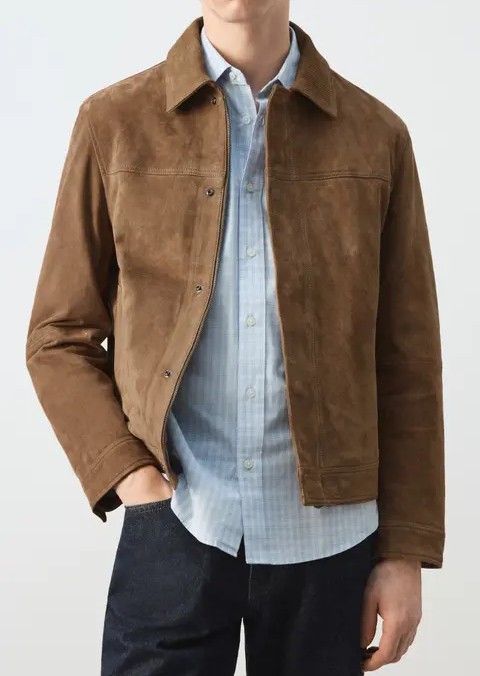
Chamois, a type of suede, was originally made from the skins of chamois goats that are native to Europe, but today, it is often made from the hides of deer and domestic sheep and goats. Chamois is used to polish or buff wood and painted objects like cars because it is soft, flexible, and does not scratch. Rain, wet snow, and other moisture damage suede. Suede cleaning should be done by specialists.
Suede is prized for its ability to flex with and mold to the body. It has a luxurious, substantial hand. Because of its thinner nature, suede has good resilience and does not wrinkle as easily as leather. Suede can be damaged by abrasion and is expensive.
Fur
Quality and Sourcing
A fur is any animal skin or part of an animal skin to which the hair, fleece, or fur fibers are attached. Fur comes from a variety of animals: seal, rabbit, muskrat, nutria, raccoon, fox, chinchilla, mink, sheep (called shearling) and lamb, ermine, sable, wolf, coyote, and others. Some endangered animals are protected from fur harvest. In spite of this protection, poachers destroy some animals to meet the demand from unscrupulous consumers for fur from Siberian tigers, snow leopards, and others.

Fur is expensive, especially chinchilla, mink, sable, platina fox, and ermine. Fur items are considered luxury items by the U.S. government. Fur is used in apparel, slippers, boots, throws and rugs, accent pillows, wall hangings, and animal toys. Consumers usually purchase furs because of their beautiful appearance rather than for their warmth, durability, or easy care. Knowing about the kinds of fur, how fur garments are made, and how to care for them will help in making wise selections and in maintaining the beauty of the item.
Furs are natural products and vary in quality. Good-quality fur has a very dense pile and is soft and fluffy. If the fur has guard hairs, they are long and very lustrous. Quality depends on the age and health of the animal and the season of the year in which it was killed. Furs are usually harvested in late fall because the coat is densest and has minimal sun and abrasion damage. Fur has a natural, one-directional nap.
Dressing, Dyeing, and Finishing
Fur trapping has long been an important industry in many parts of the world. Begun in 1880, fur farming produces better pelts as a result of scientific breeding, careful feeding and handling of the animals, and harvesting the fur when it is in prime condition. Silver fox, chinchilla, mink, Persian lamb, and nutria are commonly raised this way. Persian lamb is also known as karakul, caracul, or astrakhan. This fur is the pelt of newborn Karakul sheep. It has a distinctive tight, curly pattern of usually black or dark gray hair.
Crossbreeding and inbreeding produce new and different-colored furs. However, efforts by animal-rights activists to decrease the use of furs have had a negative impact on fur farming and demand for fur products.
The cost of fur depends on fashion, the supply and demand for fashionable furs, and the labor required. Skins are gathered together from all over the world and sold at public auctions. Furs go through many processes before they are sold as products. The dressing of fur is comparable to the tanning of leather. It keeps the skins from putrefying and makes them soft and pliable. Dressing requires more care than leather so that the surface hairs or fibers are not damaged. After dressing, pelts are combed, brushed, and beaten. The final step, drumming in sawdust, cleans and polishes the hair and absorbs excess oil. Brushing or vacuuming removes the sawdust.
Many furs are dyed. Dyeing makes less expensive furs look like expensive ones. For example, muskrat may be dyed to resemble seal, and rabbit may be stenciled to look spotted. Dyeing improves fur’s natural color or gives an unnatural color such as red. Tip-dyeing brushes the tips of the fur and guard hairs with dye. In dip-dyeing, the entire skin is dipped in dye. Some furs are bleached, and some are bleached and then dyed. Repurposed fur makes new products from existing fur items.
Care and Storage
Furs require special care to keep them beautiful. They should not be stored in damp or hot, humid places and never in plastic bags. Between seasons, cold storage at a furrier’s keeps furs in special temperature- and humidity-controlled vaults. To restore luster and clean the garment, send it to a furrier once a year. Furs should only be cleaned using the furrier method. In the furrier method, the fur is tumbled in an oil-saturated, coarsely grained powder. The powder absorbs soil, adds oil to the fibers and skin, and cleans the fibers without excessive abrasion and matting. Careful brushing and vacuuming remove the excess powder. Sometimes after cleaning, a small amount of the powder remains in pockets.
Protect fur from abrasion. Avoid sitting on fur garments. Hang them on a wide, well-constructed hanger and allow plenty of space between garments. Shake garments; do not brush them.
Conclusion
Leather, suede, and fur are all part of the wider family of animal textiles, but each one has its own structure, finish, and care routine. Leather stands out for durability and versatility, suede for its soft, velvety surface, and fur for its dense pile and luxury appeal. The way each material is processed explains both its cost and its handling needs. With that basic knowledge, it becomes easier to choose, use, and maintain these materials with confidence, and that understanding will stay useful as style and demand continue to shift.

Founder & Editor of Textile Learner. He is a Textile Consultant, Blogger & Entrepreneur. Mr. Kiron is working as a textile consultant in several local and international companies. He is also a contributor to Wikipedia.


